
October 9, 2026
How far can hikers go at each experience level?
How far can hikers go at each experience level?
A 10 km hike can be a comfortable walk on an even track or a demanding day on a steep, rocky trail. Choosing a realistic distance means considering experience alongside elevation gain, terrain, weather and available time. The ranges below are planning guides, not targets that every hike must meet.
From first-time hikers to athletic hikers: what distances make sense?
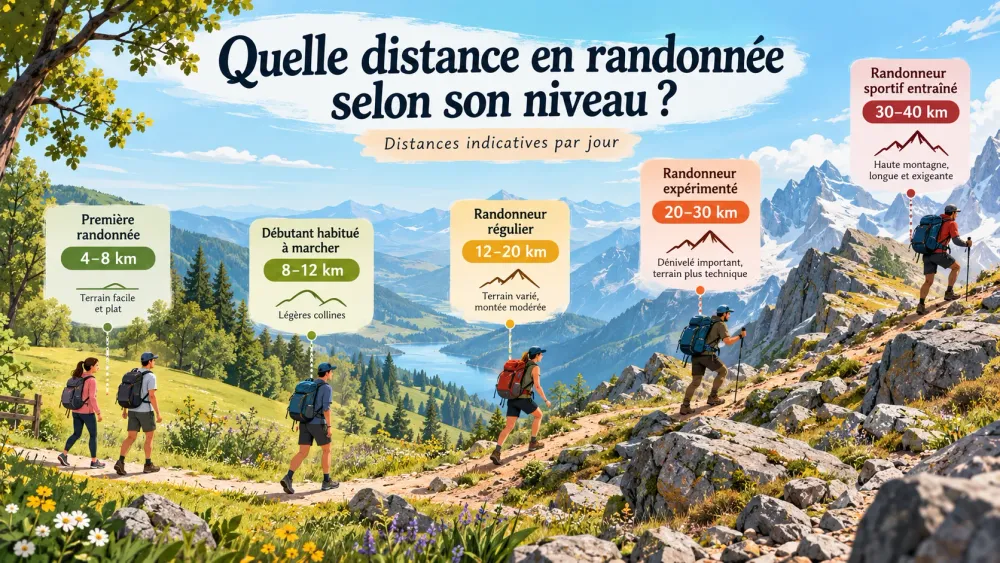
On a marked trail, in mild weather and with a light pack, a first outing of 4–8 km leaves room for breaks and unexpected delays. With practice, 12–20 km can become a feasible day hike. Beyond 20 km, endurance and careful pacing matter increasingly. The table gives indicative planning ranges, not official standards or guaranteed completion times.
| Experience level | Indicative daily distance | Indicative total time, including breaks | Suggested elevation gain | Suitable outing |
|---|---|---|---|---|
| First hike | 4–8 km | 2–3 hours | 0–200 m | Easy trail with a simple return |
| Beginner accustomed to walking | 8–12 km | 3–5 hours | 100–300 m | Moderate hills and regular breaks |
| Regular hiker | 12–20 km | 4–7 hours | 300–700 m | Day hike on varied trails |
| Experienced hiker | 20–30 km | 6–10 hours | 600–1,200 m | Long day at a controlled pace |
| Trained, athletic hiker | 30–40 km | 8–12 hours or more | 800–1,600 m | Demanding outing in favorable conditions |
These ranges assume a non-technical route: an exposed alpine hike or a section requiring hands cannot be judged by distance alone. The French Hiking Federation offers route information for walks in France; the difficulty shown on a route description deserves as much attention as its length.
Why can a 12 km hike take almost the whole day?
A simple estimate divides distance by a cautious pace of 3 km/h, then adds roughly 1 hour for every 500 m of ascent, plus breaks. A route of 12 km with 500 m of elevation gain therefore suggests 4 hours based on distance, 1 hour for climbing and 45 minutes of breaks: approximately 5 hours 45 minutes in total. This is a planning aid, not a prediction. Difficult descents, heat and fatigue can extend the day further.
A map helps reveal those factors before departure. For routes in France, contours and route profiles on Géoportail, the French national mapping service help distinguish a steady climb from repeated steep hills. A short, steep loop can demand more effort than a considerably longer flat walk.
How should terrain, weather and the group change the plan?
Kilometers generally come more easily on a stable, clearly marked path. Mud, loose stones and long descents slow progress and tire the legs. A heavier pack, especially on a multi-day trip, changes the calculation too: a shorter first stage is safer than automatically repeating a familiar day-hike distance.
Weather affects both exertion and safety. Strong heat calls for an earlier start and confirmed water options; rain, wind or thunderstorms may justify a shorter route or a postponement. Local forecasts and alerts from Météo-France should be checked the day before and again on the morning of departure. For a group, the route should suit the least comfortable participant, particularly when children are involved.
How can a realistic route and its access be checked?
An easy loop with a straightforward starting point and an option to shorten the walk often makes a good first outing. The advertised trail length is only part of the journey: walking distance from a train station, bus stop or car park also counts. On a point-to-point route, the last available return service matters. A description on MonGR®, the French Hiking Federation’s route portal, can complement an IGN map.
The table contains educational estimates, not measurements made on a dated site visit. For a specific trip, access and conditions should be checked the day before departure and again on the day: review the route information and local notices for closures, seasonal restrictions and transport changes. This article does not confirm any route’s live opening status. Leave a margin before nightfall and identify a backup route. On a multi-day hike, a stage completed once is not necessarily a sustainable daily distance.
Conclusion
The best distance is not the longest; it is the one that leaves enough time and energy to finish safely. 4–8 km for a first hike, 12–20 km for regular hiking and 20–40 km for trained hikers provide useful starting points, subject to the conditions of each route. A current French Hiking Federation route description and a recent conditions check are more useful than a distance figure alone.
FAQ
What distance works for a first-ever hike?
An easy 4–8 km loop with little elevation gain and a straightforward return is a cautious starting point. Actual duration will depend on breaks and terrain.
How far can a regular hiker travel in one day?
12–20 km can be feasible on a non-technical route, provided fitness, elevation gain and weather are suitable.
Does elevation gain matter more than distance?
Both matter. 500 m of ascent can add roughly 1 hour to a distance-based estimate; a steep descent can also slow progress considerably.
Is a 30 km hike suitable without training?
Generally not. This distance calls for endurance already tested on shorter hikes, plus planning for the terrain, walking time and return journey.